
Take One! with Visual PR Productions
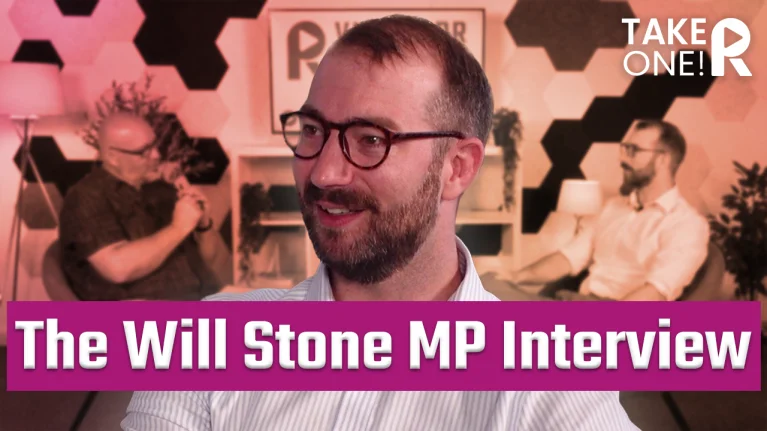
Chris Dawes in conversation with Will Stone MP, Labour MP for Swindon North, recorded in our Swindon studio. Engaging conversations. Authentic stories. No scripts. One take.
Swindon's drone industry did not exist five years ago. Today the town is home to the UK's largest drone manufacturer and, according to Swindon North MP Will Stone, the largest uncrewed systems testing facility in Europe. We sat down with him in our Swindon studio for the latest conversation in our Take One! series to find out how.
Take One! is where we do the thing we spend most of our working life encouraging other people to do. No script, no questions submitted in advance, no second take. This one had been on our list a long time, and an earlier attempt was postponed because Will had a meeting with the Prime Minister, which is difficult to argue with.
The coverage focused on the job losses, understandably. But the damage ran deeper, and understanding that is the key to everything since.
Honda paid substantial business rates into Swindon Borough Council. Thousands of employees had discounted access to vehicles, meaning more disposable income circulating locally. And an apprenticeship pipeline gave young people a route into skilled work without leaving the area.
All of it went at once, and as Will puts it, the loss of ambition was as damaging as the loss of income. Which is why replacing the jobs alone was never enough. Warehousing could have absorbed some of the workforce. What it could not do was rebuild the business rates base, the apprenticeship route, or the sense that Swindon was a place where things get made.
Will set out three commitments as a parliamentary candidate and asked to be held to them. Reindustrialise the town. Improve access to education. Address mental health provision. The first had no obvious sector attached, and when he began approaching defence companies, the response was not encouraging.
"They kind of laughed. They said there's no defence industry in Swindon, no reason for us to move here."
One of those companies is now considering a move to the town.
What changed was not a single announcement or a pot of central funding. It was volume. Will estimates he has now met between 170 and 180 companies. The door-opener was a minor party role, the Labour Business Champions scheme, which he describes candidly as a position created to keep backbenchers occupied and disbanded within a year. He used the title purely as a reason for industry to take his calls.
Alongside the meetings came the homework. He had never handled a drone before entering Parliament, and spent evenings reading technical material on how the systems work.
"If you want industry people to respect you, and if you want them to engage with you, you have to have a little bit of understanding."
The most persuasive part of the story is not the anchor manufacturers but what has grown around them. TEKEVER, the largest of the drone manufacturers, operates from the former Spectrum building, and STARK produces one-way effectors. But the cluster now pulls in businesses with nothing to do with building aircraft.
Each addition makes the next conversation easier. The pitch is no longer cheap land and proximity to London; it is that a company relocating to Swindon arrives with composites, logistics and specialist support already in place. The collaboration is genuine too: more than twenty defence SMEs backed the bid for a defence technology college, because a shared skills pipeline benefits all of them.
This is the concern Will hears most often locally, and he addresses it rather than dismissing it. Swindon's surroundings already make it strategically significant, with the Defence Academy, Brize Norton and Lyneham all nearby. On smaller-scale attacks, his position is that the capabilities people worry about do not have the range to reach the UK. He points to comparable sites: Filton, home to Airbus. Preston, where BAE builds Typhoon. Barrow, where nuclear submarines are built. None has been targeted.
Notably, he does not treat the concern as foolish, seeing it as a gap in public information rather than unreasonableness. It is a theme running through the whole interview.
"Just because you don't know something doesn't make you an idiot. It just means you don't know something."
An interview about manufacturing could have stayed on comfortable ground. This one does not, and it is better for it.
Will talks about the Harry Parker Bill, formally the Road Traffic (Unlicensed Drivers) Bill, which he introduced in February 2025 following the death of fourteen-year-old Harry Parker on Akers Way in 2022 and the collapse of the criminal case. He describes working alongside Harry's parents, Adam and Kelly, and the difficulty of writing a speech that could do justice to a family sitting in the Commons gallery.
He is honest about the weight of it, and that his team carry it alongside him. Asked how he copes, the answer is practical rather than profound. Structure. Fitness every morning. Painting Warhammer models in the evening. Rejoining the Reserves, partly for a focus with nothing to do with politics. It is the section that explains the rest of it.
Asked for the emotional case for the town rather than the economic one, the answer comes back immediately.
"It's my town. I want it to be the best possible place."
Born at Princess Margaret Hospital. Beech Grove, then Ruskin, then Headlands. Into the Army from there. His argument rests on the people rather than the geography: a proud working town built on the railway, on automotive manufacturing and on aerospace, with an industrial capacity and a work ethic few places within reach of London can match.
The five-year targets follow from that. 5,000 drone manufacturing jobs. A college delivering courses aligned to the industry. A mental health hub, for which he has floated the derelict former David Lloyd site at Kembrey Park as a possible home, presented as an idea rather than a commitment. And traceable outcomes from the 20 million pounds of Pride in Place funding coming into Penhill, because large sums have come to Swindon before and residents cannot say where the money went.
The full interview runs around forty-five minutes and covers a good deal more than we have summarised here, including why he prioritised defence over green technology, dual-use technology beyond the battlefield, apprenticeships, how he handles misinformation online, and why he intends to serve two terms rather than build a career. Chapters are included so you can jump to what interests you.
Prefer to listen? This conversation is also available as a podcast on Spotify, Apple Podcasts, Amazon Music and all major platforms: https://takeonewithvpr.transistor.fm/
The closure cost Swindon far more than the direct job losses. It removed substantial business rates income from Swindon Borough Council, reduced spending power across local businesses, and ended an apprenticeship pipeline that had given young people a route into skilled work. Since then the town has attracted advanced manufacturing and defence technology companies, with drone and uncrewed systems manufacturing becoming the principal growth sector.
Will Stone, MP for Swindon North, states that Swindon is now home to the UK's largest drone manufacturer and the largest uncrewed systems testing facility in Europe. The cluster has grown from effectively nothing in the last few years and now includes manufacturers, composites suppliers, logistics providers and specialist defence consultancies.
Companies named in this interview include TEKEVER, which operates from the former Spectrum building and is described as the UK's largest drone manufacturer, and STARK, which produces one-way effectors. The wider supply chain includes iCOMAT, a composites business and University of Bristol spin-out, established Swindon logistics firms, Nova Blue Technologies in Chippenham, which provides digital security clearances on a subscription basis, and SDO Associates, which supports defence SMEs. The list continues to grow.
Take One! interviews are recorded in one sitting, with no script and no questions submitted in advance. The approach is conversational rather than presentational, because people speak more naturally answering questions than delivering prepared lines, and the most valuable moments are usually the ones nobody planned. Visual PR Productions films this way for interviews, profile videos, testimonials and training content, and handles everything from the recording through to the edit, clips, captions and written content that comes out of it.
Every organisation is sitting on more than it realises. It lives with the founder who remembers why the company started, or the person who can explain in thirty seconds what the brochure takes two pages to obscure. Getting that out of people is what we do.
Visual PR Productions is a video production company based in Swindon, working with businesses, charities and organisations across Wiltshire, the South West and the Thames Valley. Our studio is an easy trip for clients across the region, and where it suits the project better, we come to you. If you are not comfortable on camera, that is the normal starting point rather than a problem, and it is the part we handle.
Get in touch and let's talk about what that could look like for you.
Email: enquiries@visual-pr.co.uk or complete the enquiry form
Phone: 01793 209806
YouTube: www.youtube.com/@VisualPRUK