
Learning how to be natural on camera is the biggest thing standing between most business owners and the video content they want to be making. And the good news is that it has almost nothing to do with getting better at presenting.
"I'm just not good on camera." It is one of the most common things we hear at Visual PR Productions here in Swindon, and it comes from confident, capable people who lead teams, win pitches and talk about their work with real passion every single day.
Our answer is always the same. Good was never the requirement. The only question that matters is whether you feel comfortable enough to talk properly, and that is not something you have to fix in yourself. It is something we build into how we work.
Because being in front of a camera is not a natural place to be. It is not a natural place to be for anyone. Nobody grows up doing it, most people do it a handful of times in their lives, and the ones who make it look easy have usually had a great deal of practice or a great deal of help. So the job is not to turn you into a presenter. The job is to change the situation so that presenting is not required.
Chris uses one reframe with almost every client, and it does more good than any amount of technique coaching.
Imagine you are down the pub with some mates, or sat around a table with family, and someone asks what you do or why you started the business. You would not reach for notes. You would just talk about what you know, what you have done, what you believe in, what genuinely fires you up about your products, your services and your people.
That is the register we are aiming for. Not casual in the sense of unprofessional, but relaxed in the sense of unguarded. And it is worth being clear that this is not a lower standard than presenting. It is a different and better one, because it produces two things a prepared delivery cannot.
The instinct when facing a camera is to reach for a script, and it makes complete sense. It feels like control and it feels like preparation. In practice we tend to avoid it, and the reason is mechanical rather than anything to do with ability.
A script asks you to do two jobs at once. One part of your attention is on the meaning of what you are saying. The other part is on retrieval, checking whether you have the words right and whether you missed a line. That is genuinely difficult, and it is difficult for everyone. Take the retrieval job away and all of your attention goes back where it belongs.
Chris has a name for what happens when the pressure to deliver takes over. Rigid presenter mode - that internal voice saying I have to give them all of this information and I have to sound professional. It can arrive with a script or without one, and it is not a sign that someone is bad on camera. It is a sign that someone has been asked to perform when they should have been asked to talk.
This is the heart of it. Your goal on camera is not to present well. It is to be understood, to be believed, and to create a personal connection with whoever is watching. Those are different objectives and they ask very different things of you.
Presenting is about polish, and polish is hard work. Being understood is about clarity and honesty, which you already have in abundance about your own business. Presenting asks your audience to admire you. Being believed asks them to trust you. For a business trying to win work, build a reputation or attract talent, trust is the outcome that pays.
Once you accept that, the pressure lifts. You are no longer auditioning. You are just explaining something you already know to someone who wants to hear it.
None of this happens by telling someone to relax and pointing a camera at them. The process does the work, and it is designed so that the easy version is the one that produces the best results.
Most of what we produce is conversational. Chris asks the questions and you answer them, which is a far easier task than delivering a monologue and something you already do every day. Where the finished piece needs you speaking directly to the viewer, we simply edit the questions out, leaving a run of natural answers with no interviewer present.
Tangents, repetitions and lost threads are all removed in the edit. Nothing you say has to be right first time, and knowing that in advance is often the thing that lets people breathe out and start talking properly. The same approach works across podcast episodes, feature and brand videos, profile films, client testimonials, training material and induction content, and it applies equally to a thirty second clip or an hour long conversation.
It is worth saying that every organisation we work with is sitting on far more content than it realises. It lives with the founder who remembers exactly why the company started, or the technician who can explain in thirty seconds what the brochure takes two pages to obscure. That material stays untapped not because there is nothing to say, but because of an assumption that saying it on camera requires a skill nobody in the building has. It does not. It requires a conversation, and someone whose job it is to make that conversation feel easy.
Visual PR Productions is based in Swindon, with a studio that is an easy trip for clients across Wiltshire, the South West and the Thames Valley. Bristol, Bath and Reading are all comfortable runs.
Where it makes more sense to film on your own premises, with your own people and your own surroundings in shot, we come to you. We work across the region regularly and travel further where the project calls for it, so if you are outside the immediate area it is still worth asking.
A significant part of what we do is helping people who have never been in front of a camera, or who have tried it before and did not enjoy it, discover that it can be a comfortable and genuinely enjoyable process. That matters commercially as well as personally, because people who are comfortable give you far better content, and they are willing to do it again.
That is the normal starting point rather than the exception, and it is not something you need to resolve before getting in touch. Comfort comes from the format rather than from practice, so a conversational interview where you are answering questions removes most of the difficulty straight away. Nothing has to be right first time, because anything that does not work is removed in the edit.
No. Public speaking and on camera work are different skills and neither is a prerequisite for the other. Conversational video works because you are answering questions rather than delivering a presentation, which is something most people can do comfortably with the right support.
In most cases, no. A script asks you to remember the words and communicate the meaning at the same time, which divides your attention. Working from prepared themes rather than prepared sentences is easier to do and almost always produces more natural and more usable material.
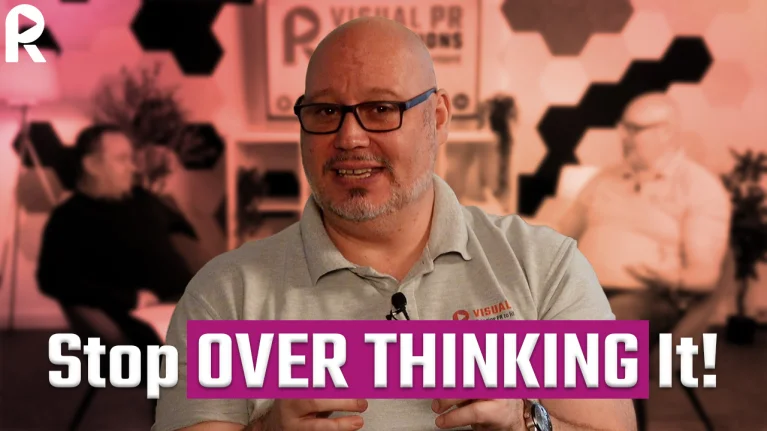
Chris explains the approach in his own words in the short video below.
You do not need to become a presenter. You do not need to memorise anything. You do not need to feel comfortable on camera before you pick up the phone, because that is the part we handle. You just need to be willing to have a conversation about what you know.
Visual PR Productions works with businesses, charities and organisations across Swindon, Wiltshire and the South West to produce video content that feels natural, builds trust and genuinely represents the people behind the brand. Get in touch and let's talk about what that could look like for you
Website: www.visual-pr.co.uk
Email: enquiries@visual-pr.co.uk
Phone: 01793 209806